Monday, June 6, 2016

Ramadan Reads

Welcome to Monday, June 6, 2016, the beginning of Ramadan!

In my novel, Out of Nowhere, the main character, Tom Bouchard, is dismayed to learn that Ramadan ... the Muslim holy month of fasting, alms giving, and much more ... falls during the height of his team's soccer season. And four of their star players are Muslim! Predictably (for the evolving Tom) his primary concern is how this will affect their performance on the field.

Writing Out of Nowhere gave me a marvelous "excuse" to seek out and get to know Muslim teens in Maine and ask them about their faith and their various cultures. Much of the novel is based on anecdotes they shared and insights they trusted to confide.

Despite all I learned from them, I continue to be surprised by what I don't know or understand about this holy month. So in the interest of deepening my own knowledge and sharing a wealth of terrific titles for all ages, I'm going to post, throughout the month of Ramadan, about books for both children and adults which not only explore Ramadan but also include stories with Muslim protagonists. It's all part of #RamadanReads and I encourage you to follow that Twitter hashtag and check out the wealth of books people are talking about.

I want to kick off with Moon Watchers: Shirin's Ramadan Miracle, by Reza Jalali, illustrated by Anne Sibley O'Brien.  Moon Watchers offers an inside view of daily life in a modern Muslim family during Ramadan. Shirin and her older brother Ali have a history of not getting along, so when she discovers him sneaking food one afternoon during his Ramadan fast, she is tempted to tease him about his weakness. Instead of tattling, Shirin decides to mind her own business. She is determined to prove to her parents that she is ready to participate in this important rite of passage. Ultimately the little sister is surprised by a gift from her brother. Readers from all faiths will appreciate this universal story with its thought- provoking focus on family life.

From now until July 6th (Eid al-Fitr) I'll share a book per day. Happy reading!

Friday, May 27, 2016

Graduation Agonistes

This cake tasted as good as it looked.
I live in a college town, so in addition to ordering mulch for the garden, hosing down the deck furniture and spraying beneficial nematodes on the lawn (which is a whole other blog post; trust me, you’ll want to know) the Rites of Spring include Graduation. Every. Single. Year. Think: Bill Murray in Ground Hog Day.

Don’t get me wrong: I love ceremony. I love pomp and circumstance, the gathering of friends and family to mark Major Life Milestones. Massive luncheons prepared by dining staff. Tents. Speeches. Oh, speeches. One group of fairly hilarious professors I know has come up with an entertaining way to endure those speeches … but I digress. And should not reveal their secrets.

Here’s the thing: graduations are wonderful, complicated, emotional affairs, which can be tremendously fun and painfully fraught. Things can go well … and things can go wrong. Seriously wrong. If I had one single piece of advice for the parent of a rising college graduate it’d be this: Don’t Get FERP’d.

As in Family Education Rights and Privacy Act, a law affectionately known as FERPA.

FERPA figures prominently in my next novel, Wrecked. It’s the reason why the details of judicial proceedings on a campus are not made public. It’s the reason why you can’t see your students’ grades, or find out what courses they’ve registered for, or even pay their tuition bills online (!) unless they, the students, grant you access.

FERPA was enacted back in 1974. I know this because in 1978, the family who lived next door to us in Jersey got FERP’d.

They were a big family, five kids, and their oldest, I’ll call her Jill, was about to graduate from an out-of-state university. I was friends with Jill’s younger sister, “Jane,” and watched as the whole brood piled into their van and headed off for the festivities. When they returned, several days later, I dropped by to ask how it went.

“Terrible,” Jane said. “We never saw her.”

“Wow,” was my initial reaction. I knew it was a massive school, but when you couldn’t even find your grad … “It was that crowded?”

“No, she wasn’t there. She never graduated. She wasn’t on the program, she wasn’t in her room, and her friends won’t tell us where she went. Turns out she failed a couple of classes, didn’t qualify to graduate, and now she’s hiding from my dad.”

My 17-year old, goody-two-shoes self couldn’t quite take this in. I could understand delaying telling your parents the bad news: Mom and Dad: I washed out in chemistry. I’ll need to pick up those credits later. No graduation yet. This would be hard, possibly really hard if you didn’t have understanding parents. But the alternative? Withholding the info until they showed up and couldn’t find you, left to wander the campus, alive with celebrating hordes of happy families and cap-and-gown-clad 20-somethings? Brutal.

FERPA was most certainly not at fault here: Jill was. She should have put on her big girl pants and come clean with her family. But FERPA most definitely precluded any chance her suspecting parents might have had of discovering the truth on their own. If they had called the school and flat out asked: Is our daughter graduating? They would have been told, by law: We can’t tell you. Ask her.

I’m not exaggerating. This is truly how it works.

Anyway. My neighbors survived, as families do, and muddled on. I have no clue what pyrotechnics accompanied the eventual face-to-face between the errant non-grad and her parents, but in subsequent months/years I did see her come and go from that house and Jane told me her big sister eventually earned her degree. But the incident branded my future mother-of-a-grad self and informed what happened when my own son, known in this blog as The Dude (see earlier posts) was scheduled to Walk the Walk some 35 years later.

Scroll ahead: several weeks before The Dude’s college graduation. A pervasive unease disquiets me. I can’t shake it. I should be excited, right? Our clan is gathering, we’re planning fun cookouts with The Dude’s friends and their families, I have hotel reservations … why do I have this sense of dread?

Here’s what’s to know about The Dude: he’s delightful. He’s smart and funny and charming … and prone to skim the details. The fine print. What, me worry? is not exactly his mantra, but his lack of concern about certain things most definitely contributes to my worry. And one tiny, itsy, bitsy detail was haunting me: in his final spring semester, The Dude took three courses, instead of the usual four. I kept doing the math, and couldn’t shake my sense that this did not add up to a diploma.

“Mom,” The Dude assured me, “I’m fine. I earned other credits along the way. I met with my advisor and she said I’m all set.”

I think: Who is your advisor? What is her number? I want her to tell ME. The mother. One of the parents who has been paying the tuition.

Instead, I say: “Oh, that’s great. Thanks for handling that. Sorry to keep asking. You know me! Such a worrier.”

Things might have been okay at that point. But then, Facebook stepped in.

I won’t further lengthen this already long post by expostulating on the horrors of Facebook (let’s just say it’s the root of all social dysfunction) but in the weeks preceding The Dude’s Big Event a friend whose son was about to graduate from another college began “sharing” all their news. This “sharing” included photographs of the lovely embossed invitation his son’s college sent to parents.

We had not received a lovely embossed invitation. And god knows: we’d paid enough for one. In addition to that, we had received only one, ONE, email from The Dude’s college apropos to graduation. This had arrived many weeks earlier and basically said Check with your student to make sure they have met all the requirements for graduation. After that: radio silence. And this from a college known for a constant, virtual tidal wave of emails/messages/reminders about various events on campus.

I think:  SOMETHING IS WRONG SOMETHING IS DEFINITELY WRONG HE’S NOT GRADUATING I WOULD HAVE GOTTEN A LOVELY EMBOSSED INVITATION AND EMAILS ABOUT GRADUATION HE’S NOT GRADUATING HE’S TOO DAMN CLUELESS TO EVEN KNOW IT

I say (to my husband): “You know, I’m going to email his class dean and find out how we can confirm that he’s all set.” “Go for it,” the spouse said. Note: the spouse was not one bit worried.

You can imagine what followed. I emailed said dean, who replied, FERPA-like: “We are unable to confirm your student’s status toward meeting his graduation requirements. Please confer with your student.” Or something to that effect. I didn’t save the actual email. Suffice to say: I was FERP’d.

Cortisol spike.

I think: WTF???? I KNEW IT I KNEW IT HE’S NOT GRADUATING OMG IT’S JILL FROM JERSEY ALL OVER AGAIN OMG!!!!!

I say (to the spouse): “I don’t have a good feeling about this. It’s time to call The Dude.” The spouse nods. He knows me.

One Ringy Dingy. Two Ringy Dingies. I reach voicemail.

I think: HE’S NOT PICKING UP HE’S EITHER HALFWAY TO LAS VEGAS WHERE HE’S HOPING TO HIDE FOR THE REST OF HIS LIFE OR HE’S CLUELESSLY GOING ABOUT HIS BUSINESS NOT REALIZING HE’S NOT GRADUATING OMG!!

Several hours later, a text from The Dude: What’s up?

I called. I dumped. All the emotions. About the FERPA Nazi in the dean’s office, the lovely embossed invitation my friend was sharing on Facebook, maybe even Jill and New Jersey. After exhausting myself, utterly, I waited.

“Oh,” The Dude finally said, chastened. “I’m sorry. They sent those invitations to us weeks ago. Did you want them? They’re sitting on my desk ….”

I think: OH. MY. GOD.

I say: “Oh, honey, for sure. Please don’t throw them out.”

The Dude: “Want me to put them in the mail to you?”

I say: “Thanks, that would be great.”

The call ends, and, adrenaline spent, I collapse in a puddle on my kitchen floor.

Several weeks later, he graduated, in a bright red robe, beneath a brilliant sun, surrounded by wonderful friends. It was a fine day, although not the culminating moment. For me, that happened the day before commencement, when the grads picked up their actual diplomas at some small office window. He allowed me to photograph the event:


Cars with plates “from away” are pouring into our small town even as I type this, and I wonder what joy, what anxieties, what anticipation and concerns ride in each of those vehicles. We’ll wander, as we do every year, among the families gathered on the campus, cheer on friends and students we know and colleagues who have taught them, listen to those inevitable speeches (oh, those speeches!) then head home.

Because it’s spring, after all, and there are weeds to pull and always a lawn to mow.


Thursday, April 21, 2016

'Tis the Season

Wrecked will be published
October 4, 2016
So, here we go again. ARC time.

That’s in Advance Reader Copy, which means paperback-bound, not-for-sale copies of my latest book have gone out to selected reviewers, and on-line copies of the book are available via Netgalley.

Some of these critics are Major Gatekeepers. They review for Kirkus and Publishers Weekly and School Library Journal, places which, if the reviews are good, are cherry-picked for their best lines, which are then pasted into the book’s Amazon.com entry, or, better yet, “blurbed” on the novel’s subsequent printings.

Some are notable bloggers, folks who have attracted a sizeable following because their writing and insights and instincts about books are interesting, informed and reliable. Some are not so notable bloggers who are equally interesting.

And some are, to use one of my daughter’s favorite words: randos. As in Random Reviewers.

These are people who like to read and who might have no particular credentials. They throw up a profile on social media and pontificate, and it’s hard to know what their agenda might be (or not so hard, depending … ) but suffice to say, in these days of Goodreads, Twitter, Tumblr, Pinterest … wow, I could keep going but I won’t … their opinions do get stirred into the mix and have capacity to affect the taste of the stew.

Here’s the thing about all the critique: as an author, you can never, ever, absolutely EVER, respond to a bad review. Okay, maybe in a flagrant case where somebody completely misread your book (like, keeps referring to the main character by the wrong name?) you might consider getting a third party (your next door neighbor who places the call from a different state just to ensure anonymity) to offer the tiniest of corrections (“His name is John, not Carl.”) But generally, it is a huge, massive, life-altering gigantic faux-pas (in other words, a no-no) to confront someone who has negatively criticized your work.

Here’s the one simple reason why: they will come after you with a vengeance.

Confession time here: I made this mistake. Once. My second novel, Jersey Tomatoes are the Best, was released in ARC form without a cover. Subsequently, I read a pretty not-great review, which surprised me by its level of not-greatness. As I was harrumphing to myself about it, a brilliant thought crossed my mind: The reviewer didn’t realize this practically blank front wasn’t the actual cover! Aha! I’ll send her a jpg of the cover, explaining the error, and I’ll bet she’ll change her mind about the book!

I know what you’re thinking: Is Maria really that stupid? Answer: Yup.

I merrily sent off the jpg, with a suggestive little note that implied she’d certainly change her mind about my book if she saw this, etc. etc.

Well. The storms that unleashed. The fury. The righteous indignation, how DARE I deign to approach her, what was I THINKING??? And on and on. She also warned me to never approach her again … or else.

It gave me some insights into reviewers, and how important their opinions are to them. It also revealed to me, somewhat belatedly, that this “review” business is not a discussion. It’s not a negotiation.  It’s a judgment, pure and simple. It’s the coliseum, the mob waiting, rapt, to see whether your book lives or dies: thumb up or thumb down?

It’s not pretty.

So now, this fourth go round in the Season of Reviews, I’m finally philosophical about the whole thing. First: I can’t control reviews. I can only control what I write, and I can only strive to write my best book possible. Second: I will get good reviews, so-so reviews, awful reviews, and great reviews. Third: I will take them all with a grain of salt, rereading the good and great over and over and over, while reading the so-so and awful only once, and hoping that someday those poor misguided souls will see the light.


Finally: I will trust my editor. Because before my book goes into the world, a brilliant, insightful, experienced person read it, helped me revise it, and would never launch it if it wasn’t ready. With this latest book in particular I’ve had some great editing advice, and for that I am so very grateful.

Monday, April 4, 2016

Still Thinking About It

Wrecked is due for release on October 4, 2016.
Last night I was on the phone with my hilarious friend, Mary. This is my college friend who challenges me in more ways than I can count, whether she’s handing me a book I’ve yet to read, questioning my political assumptions, shoving my canoe down a class three rapid or asking me to taste some hairy concoction out of Ottolenghi. Mary keeps you moving forward. There’s no standing on a hill of sand when she’s around.

So when I told her the galleys for my latest novel have just gone out and reactions/reviews trickling in, her comment was, “So it’s done, right? That book is finished? Yay, you can think about something else now!” I paused.  I mean, yeah, it is time to start a new project (and I have, the tiniest of baby steps have been taken) but her comment startled me. And I realize that while I’m done writing this book, I may never be finished thinking about, and learning about, and talking about, the issues it explores.

Wrecked is the story of an accusation of sexual assault on a college campus. It is narrated by Haley (the roommate of the accuser) and Richard (the housemate of the accused.) In between their alternating chapters is an ongoing, omniscient retelling of the night and the events in question, so unlike the characters in the book, who must rely on what they are told by a variety of sources, the reader sees.  Point-of-view in the novel is not merely a narrative device: it’s a theme.

You can understand Mary’s desire for me to move on. This is not a happy topic. Actually, this is a wrenching, painful, horrible topic, and I’ve been existing in this imaginative world for years. Some of the “research” I’ve needed to do has been emotionally excruciating.

But if anything, I’m still all in on this one. And while I’m done writing the story I needed to write, I’m far from done learning and processing. I’m actually hungry for the next step, which is not only hearing from readers, but also talking, listening, learning. Some of that will no doubt emerge organically, from school visits to readings to simply chatting with friends. But I’m hoping this blog might also be a place where I can keep the conversation going.

So for starters: let me toss out three things (a book, an article, an op-ed) which have been percolating in my head this week, which also happens to be the week the galleys for Wrecked are flying out into the world. Take a look, tell me what you think:
  •        Peggy Orenstein’s Girls & Sex launched last Friday and landed on my doorstep that afternoon, (well done, Harper!) I’m halfway through and 1. It has already sparked some really important conversations between me and my daughter, and 2. Every woman needs to read this. Then talk about it. I’m still reading, so more on this book later …. 
  •        Among the many ways I “researched” Wrecked was reading current students’ writing about sex, sexual assault, and the hookup culture on campus. This piece in the April 2, 2016 issue of The Bowdoin Orient was remarkable to me not only in light of what I’m reading in Orenstein’s book, but also for the rage expressed by the writer. Take a look at "Male Entitlement Promotes a Hierarchy in Bowdoin's Hookup Culture.
  •       Writing instructors tell us to ask the question: What does my character want? I have found that to be an excellent guide as I develop a character, and throughout my writing process I’ll keep checking in on that question and expanding/honing the answer. It’s something that came to mind when I was reading a thought provoking article by Middlebury College graduate Leah Fessler ’15, who wrote her thesis about relationships on campus. I think Leah is on to something important here, particularly her observations about hookup culture, what young women want, and feminism. Check out Modern Love. 

This is what I’m reading/thinking about this week. And that doesn’t begin to approach the stack on my night table. Maybe I can convince Mary to read some of it for me and summarize …


Stay tuned.

Saturday, November 14, 2015

Tapping on our Brows

Principal Don Reiter, right
I’ll start by saying I know absolutely nothing about Maine Principal Don Reiter, or what happened in his office when he met, privately, with a student at Waterville Senior High.

But isn’t that where we arbiters of sexual misconduct always begin? Peering through tightly shut windows where the shades are drawn, then drawing conclusions about what happened? We take dueling narratives, leaven them with our opinions about the narrators (he’s a predator/angel/victim; she’s a liar/heroine/victim, take your pick) drop them onto the roulette wheels of “justice” and watch … as lives are wrecked.

Here’s the only thing we do know: somebody’s lying. One of two people is an unreliable narrator. And in the absence of any evidence beyond he said/she said, which story do we choose to believe?

Principal Don Reiter’s tale: on the first day of classes this fall at Waterville Senior High he was meeting with a female student in his office. They were sitting on the couch. She propositioned him. The meeting ended, and he reported the incident to school authorities. And his wife. Who filed for divorce a few weeks later.

What little we know from the student: during a meeting alone with the principal, he told her that he had a secret: every year he chose a student with whom to have sex, and that this year he’d chosen her. He threatened her … she’d never graduate … if she revealed this secret. She was upset, and promptly reported the incident.

Because of legal issues surrounding privacy, further information is sketchy, but if news reports are credible, other details include:

·        Shortly before classes began this fall, the student and her mother had appeared in Reiter’s office to discuss the student’s credits because it didn’t look like she was on target to graduate. He said they needed to meet with her guidance counselor.
·        After conferring with guidance, the student reappeared at the principal’s office, where she was told she needed to make an appointment.
·        On the first day of school the student was called out of class, down to Reiter’s office. At this point the closed-door meeting in question took place.


Within days of this incident, the superintendent placed Mr. Reiter on paid leave, called the cops, and investigations began. Two months and many, many interviews with staff and students later, the superintendent has recommended that Mr. Reiter be dismissed, the police have filed a report upon which the District Attorney has yet to act (she says she’ll wait to see what the school board will do) and the school board is now grappling with whether to accept … or reject … the superintendent’s recommendation to fire Mr. Reiter. As the board met this past week, crowds of Mr. Reiter’s supporters gathered outside their doors. When, after many hours of deliberations they emerged undecided and scheduled a subsequent meeting, folks were upset.

You can’t make this stuff up. Well, you can … but it’s called drama. Approaching the level of Greek tragedy. Because everyone loses. Everyone. Either Mr. Reiter is a predator, a wolf who has been prowling, undetected for years, among our innocents … or he is a cruelly, unjustly accused victim whose career and personal life have just gotten trashed.  Either she’s a traumatized victim, a child whose doe-eyed view of life has just been shattered… or a psychopath along the lines of the borderline-personality-disordered character Amy in Gillian Flynn’s bestselling novel (also a movie) Gone Girl.

If that weren’t bad enough: enter the Greek chorus. Lawyers, from both sides. The administrators who just want to make it all go away, crying for his job on a plate. The mobs of friends of the accused rallying in his support. The victims’ rights advocates claiming: see? See how difficult it is to speak out against sexual predation? This is why so many cases of rape and sexual misconduct go unreported.

My head spins. So does my imagination. Which is why I usually retreat to poetry at times like these, because what constitutes hard and fast, legal and the fair, eludes me here.

Edwin Arlington Robinson, a son of Gardiner, Maine, wrote, in his poem Eros Turannos: “We tell you, tapping on our brows, the story as it should be. As if the story of a house were told, or ever could be.”

If ever a line reaches out and grabs you by the throat, it’s that one. All of us, the readers of these disparate stories, tapping on our brows. As if we know. Could know. Perhaps the true tragedy is that we don’t have the slightest idea what went on behind that door, yet are required to judge. Life demands it. Continuing to rise and shine and work and go to school together demands it: a choice. A decision. Justice.


Someone is lying. And that lie is a Molotov cocktail thrown into the living heart of a community. Regardless of how this sad business concludes, everyone gets burned.

Tuesday, November 3, 2015

Almost there ...

Plot map for my next book.
Among the many ways I torture myself (besides stringing real cranberries and popcorn for the Christmas tree each year): rereading passages from my finished books while I’m in the early stages of writing a new book.

It’s like that scene in the movie Crimes of the Heart, where the sisters regularly sneak peeks at their father’s medical text, Diseases of the Skin. They know it will horrify them but they Just. Can’t. Stop.

Now, I realize how that sounds, and no, I’m not saying my finished work is akin to leprosy. But my “unfinished” work sure is.

First drafts and early exploratory journal entries into new worlds and new characters are terrible to behold. Well, mine are, anyway. I flounder. I grasp. I struggle to understand: who are these people and what the hell are they trying to do? I write barely comprehensible fragments, or run-on-paragraphs that lead nowhere good. I use adverbs. Lots of adverbs. Stephen King would have a field day with my use of –ly.

Somehow, miraculously (well, it’s not really a miracle, it’s called REVISION) all that bad writing eventually rights itself into a story arc; visual scenes; dialogue which isn’t cringe-worthy. You shift the tectonic plates of your imaginary world and kill off characters left and right until you can focus on the small stuff. Tweaks. Like, Is that really the verb I want here? Should I use a pronoun or proper noun here? Should I change her ring tone … ?

Yesterday I wrapped up the almost-final draft of my next book (I say “almost final” because it still has to go to a copyeditor, who checks for typos, inconsistencies, the sort of nit-picky stuff that drives me crazy but can absolutely sink your book if you miss it so yay for copyeditors!) which means I’ve been living with The Small Stuff for a few weeks now.

Coincidently, my writer friend, Paula Bourque, asked via Facebook for other writers to share their late-stage revision tips, and a treasure trove of terrific suggestions poured in. A few I knew/already used, but several were brand new to me, and turned out to be super helpful. Here are a few of my favorites:

From Lynda Mullaly Hunt: Set a day aside and read the entire thing out loud. You hear things you don’t hear when reading silently. (Thanks, Lynda! I read myself hoarse.)

From Cynthia Lord: Change the font and print a copy. It will look different enough that your eye will read every word again … if it looks familiar your eyes sometimes read what you think it says, not exactly what it does. (This was a great idea, Cindy. I swapped Times New Roman for Arial and found all sorts of errors.)

From Sarah Albee: Do a ‘find/replace’ for words you suspect you use too much. (Wow. My characters frowned and shrugged way too often! Glad I checked.)

From Lynn Plourde: You can delete “that” most of the time. (THAT is so true, Lynn!)

From Megan Frazer Blakemore: Give yourself breaks and walk around, even if it’s just around your house. (I don’t think I did this enough, as my aching back will attest ….)

From Kate Messner: When I review copyedits, I take a blank piece of paper to cover up everything beneath the line I’m reading – helps me to slow down. (I will definitely do that when the dreaded copyedits come back!)

My own late-stage tip is to hunt down adverbs and the verb “to be,” replacing them as much as possible with vigorous, transitive verbs. Examples of writers who “do verbs” brilliantly: Anthony Doerr in All the Light We Cannot See and E. Annie Proulx in The Shipping News. I’m a big believer in verbs.

Okay, now: to follow Megan’s advice and get out of this chair.  No, better yet: vault from this chair!  (See? Didn’t that create a picture in your mind?)


Monday, October 19, 2015

Poem for a Monday

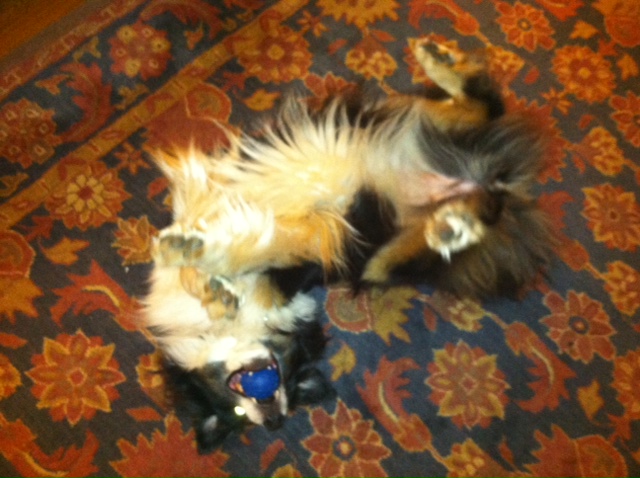
Frisbee, ball in mouth.
The past five months I’ve spent even more time than usual attached to a chair. General household order and muscle tone number among the casualties, but The Revisions to the Next (as yet unnamed can you believe it?) Novel are almost done.

No one will be happier to see this phase of the writing process end than my Australian Shepherd, Frisbee.

“Ah,” say those of you who know Aussies. You say this as you envision flying plastic discs, bouncing tennis balls, and random sticks hurled boomerang-style. You say this as you imagine an exhausted middle-aged woman trudging outside in all sorts of weather (Maine’s coastal weather can be summed up as “all sorts,” often within a 15-minute span) because an Aussie will walk. Every. Single. Day. You say this knowingly, even though I would delete the word, because it ends in –ly, making it an adverb, which, in this season of revision means it must go, go, GO!

As Stephen King warns in his memoir, On Writing, “The road to hell is paved with adverbs.” And let’s face it: Stephen King would know how the road to hell is paved.

For those of you who don’t know Aussies, think: somewhat dumber Border Collie. In other words, busy in the extreme, focused to the point of obsession, relentless … with a side order of lovable goofiness. If the Border Collie is the Harvard student with perfect SAT scores, the Aussie makes the honor roll and gets into the respectable safety school. Then plays Ultimate. Or rugby.

At any given moment as I write, rewrite, and unwrite (which feels like an appropriate word for the detangling this manuscript has needed) I can look across the room to the futon where Frisbee pretends to nap (yes, this entitled dog jumps up on the furniture) and at the slightest movement from me her eyes will open, wide, and she will channel “Are we ready to go YET??” She plays these Jedi Dog Tricks all day, and always succeeds.

I could not pull off this work without her, and in this I am not alone. I was reminded of that this weekend, not only when I read Maira Kalman’s lovely essay “True Love” in the Sunday Times, but also when I met, for the first time, in the most unexpected setting (I was wiping tables; he was sweeping floors) the author Ron Currie, Jr. who commented he’d just spent the past 12 years inside with his dog and realized he needed to get out.

The poet Mary Oliver devotes an entire volume, Dog Songs, to this bond. Here’s one that reminds me of my girl.

Percy Speaks While I am Doing Taxes

First of all, I do not want to be doing this.
Second of all, Percy does not want me
   to be doing this,
bent over the desk like a besieged person
   with a dull pencil and innumerable lists
      of numbers.

Outside the water is blue, the sky is clear,
   the tide rising.
Percy, I say, this has to be done. This is
   Essential. I’ll be finished eventually.

“Keep me in your thoughts,” he replies. “Just because
   I can’t count to ten doesn’t mean
I won’t remember yesterday, or anticipate today.
I’ll give you ten more minutes,” and he does.
   Then shouts – who could resist – his

      Favorite words: Let’s go!