Tuesday, November 3, 2015

Almost there ...

Plot map for my next book.
Among the many ways I torture myself (besides stringing real cranberries and popcorn for the Christmas tree each year): rereading passages from my finished books while I’m in the early stages of writing a new book.

It’s like that scene in the movie Crimes of the Heart, where the sisters regularly sneak peeks at their father’s medical text, Diseases of the Skin. They know it will horrify them but they Just. Can’t. Stop.

Now, I realize how that sounds, and no, I’m not saying my finished work is akin to leprosy. But my “unfinished” work sure is.

First drafts and early exploratory journal entries into new worlds and new characters are terrible to behold. Well, mine are, anyway. I flounder. I grasp. I struggle to understand: who are these people and what the hell are they trying to do? I write barely comprehensible fragments, or run-on-paragraphs that lead nowhere good. I use adverbs. Lots of adverbs. Stephen King would have a field day with my use of –ly.

Somehow, miraculously (well, it’s not really a miracle, it’s called REVISION) all that bad writing eventually rights itself into a story arc; visual scenes; dialogue which isn’t cringe-worthy. You shift the tectonic plates of your imaginary world and kill off characters left and right until you can focus on the small stuff. Tweaks. Like, Is that really the verb I want here? Should I use a pronoun or proper noun here? Should I change her ring tone … ?

Yesterday I wrapped up the almost-final draft of my next book (I say “almost final” because it still has to go to a copyeditor, who checks for typos, inconsistencies, the sort of nit-picky stuff that drives me crazy but can absolutely sink your book if you miss it so yay for copyeditors!) which means I’ve been living with The Small Stuff for a few weeks now.

Coincidently, my writer friend, Paula Bourque, asked via Facebook for other writers to share their late-stage revision tips, and a treasure trove of terrific suggestions poured in. A few I knew/already used, but several were brand new to me, and turned out to be super helpful. Here are a few of my favorites:

From Lynda Mullaly Hunt: Set a day aside and read the entire thing out loud. You hear things you don’t hear when reading silently. (Thanks, Lynda! I read myself hoarse.)

From Cynthia Lord: Change the font and print a copy. It will look different enough that your eye will read every word again … if it looks familiar your eyes sometimes read what you think it says, not exactly what it does. (This was a great idea, Cindy. I swapped Times New Roman for Arial and found all sorts of errors.)

From Sarah Albee: Do a ‘find/replace’ for words you suspect you use too much. (Wow. My characters frowned and shrugged way too often! Glad I checked.)

From Lynn Plourde: You can delete “that” most of the time. (THAT is so true, Lynn!)

From Megan Frazer Blakemore: Give yourself breaks and walk around, even if it’s just around your house. (I don’t think I did this enough, as my aching back will attest ….)

From Kate Messner: When I review copyedits, I take a blank piece of paper to cover up everything beneath the line I’m reading – helps me to slow down. (I will definitely do that when the dreaded copyedits come back!)

My own late-stage tip is to hunt down adverbs and the verb “to be,” replacing them as much as possible with vigorous, transitive verbs. Examples of writers who “do verbs” brilliantly: Anthony Doerr in All the Light We Cannot See and E. Annie Proulx in The Shipping News. I’m a big believer in verbs.

Okay, now: to follow Megan’s advice and get out of this chair.  No, better yet: vault from this chair!  (See? Didn’t that create a picture in your mind?)


Monday, October 19, 2015

Poem for a Monday

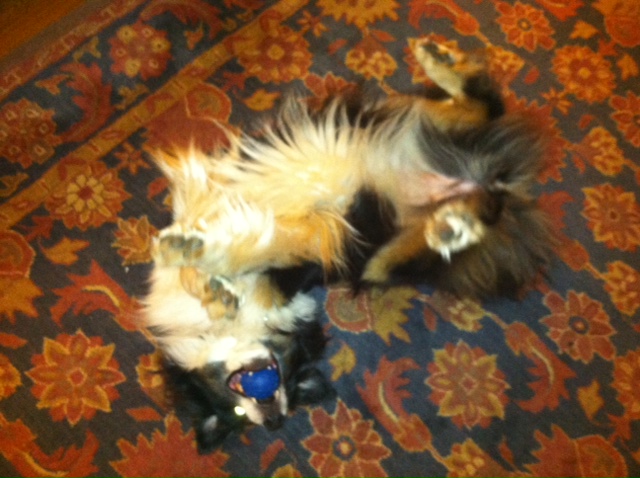
Frisbee, ball in mouth.
The past five months I’ve spent even more time than usual attached to a chair. General household order and muscle tone number among the casualties, but The Revisions to the Next (as yet unnamed can you believe it?) Novel are almost done.

No one will be happier to see this phase of the writing process end than my Australian Shepherd, Frisbee.

“Ah,” say those of you who know Aussies. You say this as you envision flying plastic discs, bouncing tennis balls, and random sticks hurled boomerang-style. You say this as you imagine an exhausted middle-aged woman trudging outside in all sorts of weather (Maine’s coastal weather can be summed up as “all sorts,” often within a 15-minute span) because an Aussie will walk. Every. Single. Day. You say this knowingly, even though I would delete the word, because it ends in –ly, making it an adverb, which, in this season of revision means it must go, go, GO!

As Stephen King warns in his memoir, On Writing, “The road to hell is paved with adverbs.” And let’s face it: Stephen King would know how the road to hell is paved.

For those of you who don’t know Aussies, think: somewhat dumber Border Collie. In other words, busy in the extreme, focused to the point of obsession, relentless … with a side order of lovable goofiness. If the Border Collie is the Harvard student with perfect SAT scores, the Aussie makes the honor roll and gets into the respectable safety school. Then plays Ultimate. Or rugby.

At any given moment as I write, rewrite, and unwrite (which feels like an appropriate word for the detangling this manuscript has needed) I can look across the room to the futon where Frisbee pretends to nap (yes, this entitled dog jumps up on the furniture) and at the slightest movement from me her eyes will open, wide, and she will channel “Are we ready to go YET??” She plays these Jedi Dog Tricks all day, and always succeeds.

I could not pull off this work without her, and in this I am not alone. I was reminded of that this weekend, not only when I read Maira Kalman’s lovely essay “True Love” in the Sunday Times, but also when I met, for the first time, in the most unexpected setting (I was wiping tables; he was sweeping floors) the author Ron Currie, Jr. who commented he’d just spent the past 12 years inside with his dog and realized he needed to get out.

The poet Mary Oliver devotes an entire volume, Dog Songs, to this bond. Here’s one that reminds me of my girl.

Percy Speaks While I am Doing Taxes

First of all, I do not want to be doing this.
Second of all, Percy does not want me
   to be doing this,
bent over the desk like a besieged person
   with a dull pencil and innumerable lists
      of numbers.

Outside the water is blue, the sky is clear,
   the tide rising.
Percy, I say, this has to be done. This is
   Essential. I’ll be finished eventually.

“Keep me in your thoughts,” he replies. “Just because
   I can’t count to ten doesn’t mean
I won’t remember yesterday, or anticipate today.
I’ll give you ten more minutes,” and he does.
   Then shouts – who could resist – his

      Favorite words: Let’s go!

Thursday, June 11, 2015

Making Mole

It’s nail-biting time.

To be clear: this is not that lovely “Between Books” interval which author Ann Packer described so perfectly in her recent New York Times essay. So I haven’t just finished the final round of copy edits on a purchased, soon-to-be-published novel, I’m not casting about for a new project whilst planning a launch party, or purchasing boxes of “signings” pens.

I’m in that post-completed-manuscript-ecstasy/pre-accepted-for-publication hell.  In other words, I finished a new novel, revised it a few times, finally got the “thumbs up” from my agent (she’s a stickler, which is why I love her) and now she’s shopping it. Which feels a little scary this time around because the wonderful, wise editor for my last three books has left our publishing house, reportedly to join the circus (she was joking when she said that, but you never know …) so Baby Book and I are searching. For a new editor; possibly a new publishing house. We wait for the phone to ring.

I know there are authors out there who would use this “down time” as an opportunity to dive into a new project, and I have a little something I’ve been playing with for a while (see last week’s post and think: Australian Shepherds) but here’s the thing: I’m still living with these other characters. I’m still tinkering, still hearing their voices. I’m not ready to leave them behind and enter a new world, especially because … but no. Won’t say it. Won’t jinx it. Karma’s a B**** and I won’t tempt the publishing gods by suggesting anything about what might happen to Baby Book and what revision might follow.

So instead, I’m cleaning my office (Baby Book made a mess), updating my website, organizing closets and making mole poblano. From scratch.

Yeah, I said that to impress you. Mole poblano from scratch. It was on my Cooking Bucket List. Three types of Mexican chilies, Mexican chocolate laced with guajillo, herbs, seeds, spices, blending, rehydrating, sieving (is that a verb?) and hours of concentrated cooking time. I cranked Carlos Santana and a little Spanish fusion music while I worked, mostly because I love it but also because I’m pretty much a Spanish “fusion” with a little Irish thrown in, and while I can serve up some pretty good Cuban food and approach my mother’s arroz con pollo, I’m a total novice at Mexican food. So I needed a little cooking Karma, a little Carlos. We pretty much believe (and by “we” I mean my mom, my daughter and I) that what comes out of the oven or the skillet is a direct reflection of what’s going on in the cook’s heart and soul.

So please, dear lord, don’t let this mole suck. Because Baby Book and I need some good mojo right now.


(Note: the above pictured mole poblano got two enthusiastic thumbs up from the spouse! Kudos to chef Shannon Bard of Zapoteca in Portland, Maine. I used the recipe from her new book, “The Gourmet Mexican Kitchen.”)

Wednesday, June 3, 2015

Hitchhikers

I’ve been thinking a lot lately about hitchhikers. I couldn’t finish my novels without them.

Let me explain.

First: these are metaphorical hitchhikers. The characters you see along the road on your writing journey. Which, to use another metaphor, is pretty much driving in the dark on a foggy night with the headlights on: you can only see about ten feet ahead, but if you keep going you’ll eventually reach your destination.

We like to think this is predictably linear, a planned plot clearly marked by lines you can see even in the dark. But that’s a lie. A sweet security blanket we cling to. Because even though the ten feet of road ahead appear straight, this highway is anything but. It curves. It dips. It angles sharply and narrows suddenly in places where the shoulder is studded with gravel or practically nonexistent or mere inches from a sheer drop. And you’re out there without a GPS or a smart phone app or even a map for goodness sake, and what the hell? What were you thinking, taking this on? I mean, this was supposed to be fun, right? A trip, a journey, possibly a vacation. Instead, it’s this trial of nerves, endurance, fortitude, faith and … yeah.

Sorry. I lapsed into metaphor. I know: writing is not parenting. Or marriage. Or even getting out of bed in the morning and putting one foot in front of the other until the day ends. It’s a job. It’s work. Creative work, true, but just that.

Right?

Second: picking up hitchhikers is dangerous. Let’s face it, sweet grandmothers carrying baskets of warm baked goods are not thumbing it on the road on cold foggy nights. These characters you see out there have knives in their backpacks. Evil intentions. You let them into your car, and you will most likely not survive.

Third: my advice is to pick them up anyway. Metaphorically, that is. Because the ride is going to be way more interesting now. Even if it kills you.

In every one of my novels an unexpected hitchhiker got into the car and started talking. Starting filling my ear with things I didn’t know, things I found fascinating. Before long, I started asking her questions. Asking for advice. Asking if he or she had any suggestions for alternate, more interesting routes.

Wow, did they ever. Not only did they suggest different routes; they suggested different destinations. Forget going to California, they said. Go left at the next light and head south to Texas. Ditch wine in Napa: we’re getting barbecue.

“But I don’t want barbecue,” I argued. “I love wine.”

“Trust us: you will love barbecue,” they insisted.

Here’s the thing: in writing, and in life, you just have to be open. Characters, real and imagined, cannot step into a closed heart or through a locked door. Let them in, and you might be in for some pain, but you might also be in for the trip of a lifetime.

In my first novel, Brett McCarthy: Work in Progress, Mr. Beady was the hitchhiker. I thought he was simply an old man having dinner with the main character’s grandmother, but then he kept showing up and saying funny things. Next thing I knew, he was steering the plot and setting up the climax for the novel.

In my second novel, Jersey Tomatoes Are the Best, Eva the ballerina was the hitchhiker. She was simply supposed to be the main character’s best friend, but then she kept turning up in scenes. At one point, when my main character was about to head to Florida for summer camp and leave Eva behind in New Jersey, I commented to my daughter, “My editor is going to make me cut Eva. I’m leaving her in New Jersey while the plot moves to Florida. She doesn’t make sense.” My (wise) daughter sighed, grabbed a stack of her own young adult novels, and tossed them on my bed. “Clearly,” she said, “Eva doesn’t simply want to come along for the ride. She wants to tell her story. You need a two-narrator novel. Check these out.” The final, published novel indeed has two narrators, and Eva is one of them.

Finally, in Out of Nowhere, Myla the college volunteer is the hitchhiker. She was simply supposed to be the random person who directs the main character’s community service job. But she was cute. Funny. Flirty. Next thing I knew, she was knocking the main character right off his feet and inserting herself in chapters. Myla ends up being the solution to many of the main character’s problems.

The novel I’ve just finished (which I won’t name here because it’s still printing from my computer) for the longest time didn’t seem to have any hitchhikers, which worried me. It was not a good sign, I thought, that no one knocked on my car window, demanding to be let in for the ride.

Until late in the game. In the final third of the book a guy named Joe steps in. The room is dark, he’s pouring powerful drinks … and he meets one of my main characters. Suddenly, we’re walking into a room I didn’t even know existed ….


Let the hitchhiker in.

Saturday, November 29, 2014

Moving Parts


I’m not a big fan of moving parts.  Not in real life, anyway.

 I like plans. I like on-time. I like predictable.  We “joke” that our family mantra is Stay in Your Rut, because our rut (aka, “tradition”) includes good things, like the annual trip to Bar Harbor and the seven Christmas cookies we always bake.

So I had more than the usual anxiety leading up to Thanksgiving this year, not only because the spouse and I had a looooong drive ahead of us to New York state (think: the northeast corridor on the busiest travel day of the year), where my parents live, but because our kids were spending the holiday together on the west coast. 

 This would involve our daughter travelling from a small town in Vermont to a small-ish airport in Vermont, flying to/changing in Philadelphia (all the seasoned travelers reading this just groaned), landing at LAX and connecting with her brother, who would expertly scoop her up at that busy airport in the still-coughing-beat-up-but-beloved-blue-Subaru and transport her back to his 20-something apartment in West Hollywood. 

Meanwhile, my sister, brother-in-law and three precious nieces were driving to NY from MA, and my brother and his wonderful brood were heading out from one location in NY to the other, while all over the news reports of fires, protests and tear gas in Ferguson were competing with Black Friday ads and hyperbolic weather reports about the approaching winter storm.

Serene I was not.  Too much of my family was on the move at the same time.

So when the first half of it all went smoothly (kids connected safely in Los Angeles where fun was had and turkey from Ralph’s was eaten) and at my parent’s house we were popping yet another cork on another really nice bottle of Pinot which someone had brought (my sibs have good wine taste) I didn’t think a thing of it when my phone chimed, indicating a text.  I happily scooped it up, anticipating a message from the kids.

But no, it was my friend from Maine.  Did you know, she queried, that we’ve had no power for 24 hours, none is anticipated for another two days and the temps might dip into the teens tonight?
            
My thoughts flew to all those still-raw Thanksgiving turkeys in Brunswick.  My shivering neighbors.  Then:  my mud room.  A poorly insulted extension of our otherwise solid house, where many pipes lead, including conduits to the washer/dryer and a gardener’s sink.
            
This is when predictable flew out the window.  Because our house was locked up tight and I had not hidden or given out copies of our keys, so no good Samaritan could go inside and fire up the wood stove and keep the pipes from freezing.  So with visions of water damage dancing in our heads, the spouse and I threw our bags in the car and began the long, dark, still slightly icy drive back to Maine.
            
Somewhere along I-84 I realized I had left the house keys on the counter of that chilly mudroom.  I do that, because we usually go in through the automatic garage doors.  Which, when the power is out, don’t work.  I broke this cheery news to the spouse as we drove, and to his credit he took it all in stride, and simply asked me to get out my iPhone and Google “How to Break Into Your Own House.”
            
You’d be surprised how many interesting ways there are to break into a house.  This kept us awake and entertained for hours.
            
Luckily, in addition to 1. Not hiding or distributing extra keys and 2. forgetting the keys, we left a window unlocked (right now you’re probably thinking, These people are too stupid to live) so I scrambled over the woodpile stacked under the eaves,  climbed in through the garage, and voila!  Entry.
            
This is where the story slows and gets comfortably predictable, which is reassuring in real life but death in fiction.  Because after we got into the house we fired up the stove, snuggled into our sleeping bags before it, and all was well.  The End.
            
But as my very wise daughter observed the next day, the best stories are in the mess.
            
“Just think, Mom,” she said when I was finished complaining about the interruption to my Thanksgiving festivities, “someday we’ll be laughing about this one. ‘Remember the Thanksgiving when you and dad had to race back to keep the pipes from freezing, while me and Christian were hanging out on the beach in Malibu.’”
            
I’ve lived through 53 Thanksgivings and the only one I clearly remember was when we dropped the turkey, pan drippings and all, on the kitchen floor, and my abuela, hoping to be helpful, slipped in the grease and landed on her ass right next to the hot bird.  As we tried to hoist her up her legs kept slipping out from beneath her, skittering wildly and further spattering grease. 
            
The other 52 were fairly calm, organized affairs, and they all run together for me.  At the time they were lovely … and forgettable.
            
The best stories are the ones with sharp edges, the ones that go pop! They aren’t always happy stories with happy endings, but they’re the ones worth telling.  They’re not necessarily stories I want to live through at the time, but it’s not I’ve got a choice.  Maybe the key to surviving those, is recognizing them.
            
The other day I treated myself to a lovely, hardcover copy of Mary Oliver’s latest collection of poetry, Blue Horses, and this one surprised me.  She seems to welcome the moving parts that scare me, and I think she must be very brave.

If I Wanted a Boat
By Mary Oliver

I would want a boat, if I wanted a
boat, that bounded hard on the waves,
that didn’t know starboard from port
and wouldn’t learn, that welcomed
dolphins and headed straight for the
whales, that, when rocks were close,
would slide in for a touch or two,
that wouldn’t keep land in sight and
went fast, that leaped into the spray.
What kind of life is it always to plan
and do, to promise and finish, to wish
for the near and the safe? Yes, by the
heavens, if I wanted a boat I would want
a boat I couldn’t steer.

Wednesday, May 28, 2014

My Writing Process


I talk to myself.  Sometimes out loud.  In public places.

It’s been going on for a long time.  I remember the first time I was made aware of it: I was 18.  I was standing in a friend’s house, in conversation with her and our mothers, when I realized everyone had stopped speaking and they were staring at me.  My mom looked horrified; the others amused.

“What?” I asked.

“You were talking to yourself,” my friend, Kathy, said.

“Uh … no I wasn’t,” I replied truthfully.  “I’m just listening.”

“Oh, yes you were,” my mom said.  “You were staring at the floor, your lips were moving, and words were coming out.  But you weren’t talking to us.”

I could feel my own eyes grow round.  I scrolled back in my mind to what had recently passed there.  I could not recall a single thing the others had just said … but a perfectly realized image of another person, a figment of my imagination, who had been regaling me with her story … popped up.

I had been talking to her.  That’s how vivid, how real, she had become, that I could turn off the actual conversation going on around me and slip into her world. 

I was mortified.  And yes, a little scared.  It was one thing to be the family daydreamer, the “absent-minded professor,” as I was known.  Perpetual preoccupation was an annoying, but endearing, habit. 

Talking aloud to make-believe people was another thing altogether. 

For me, writing has been a socially acceptable and necessary release of the pent up energies of the characters and stories which inhabit my imagination.  I don’t know why they are so insistent, but it has always been so.  Transferring their voices, their faces, and their lives, from my mind to the page is what we call “the creative process,” and I’ll confess:  it’s very hard and I don’t always enjoy it.  But for me, the alternative is odd behavior and (if you talk to my family) rotten moods, so I really have no choice.

For the past few months the blog tour known as “My Writing Process” has been alighting at author websites throughout the internet.  It involves answering four questions about writing, then passing the baton to several other writers who post one week later.  Author Katie Quirk invited me to get on board today, and it’s been fun not only to think about “process” (usually I just … do it) but also to discover many, many authors I had never come across before.

Katie is the author of A Girl Called Problem, a middle-grade novel set in Tanzania. She is currently working on a memoir about life with a newborn baby in India.  Originally from Washington state, Katie has taught English and writing for over ten years to students as diverse as Spanish-speaking third graders in the California farm belt, Berkeley community-college students, international high-school students in India, and Swahili-speaking journalism students in Tanzania. She currently lives in Maine with her husband and two kids.
So here goes!  I encourage you to visit Katie’s site and learn about her work, as well as check in with the authors I’m linking to below.
What are you working on now?  All my books to date fall into the “young adult” genre, but the manuscript on my laptop right now will most likely be considered “new adult.”  Meaning my audience will include readers 16 and older … but mostly older.  It is set on a college campus and involves a criminal accusation.  The working title is “Rage.”
I always like to try something new, narratively speaking, with each book, and this latest is a departure for me not only because the audience and subject matter is quite mature, but because I’m writing in third-person limited for the first time (my other books are all narrated in first person.)  I’m also alternating between a male and a female point-of-view, so … a lot going on.
How does your work differ from others of its genre?  I write realistic fiction and I embrace challenging topics.  Death, eating disorders, racism and next up, crime, if I had to list the order.  Peppered with plenty of humor.  I remember seeing “August: Osage County” on Broadway years ago and realizing how absolutely necessary it is, when dramatizing, to leaven brutal truth with humor.
Interestingly, my main characters all play sports, although “sports” was never my intended theme.  Soccer dominates, as does tennis.  It’s come as quite a surprise to me, because while I love sports and play sports, I was quite a music and literary geek in school.
Why do you write what you do?  I never intended to write realistic, young adult fiction:  it simply happened.  Now, I’m incredibly grateful to have found a creative outlet in this genre.
Young people lead with their hearts when they read, and I love getting on board that emotional roller coaster with them.  I love creating characters they love and hate, story lines they tear through, books they reread.  The books that changed my life were all books I read as an adolescent.  When I open my email and some young reader from a middle school thousands of miles from my home in Maine tells me he LOVED one of my books … that’s incredible.  It’s such a gift, such a privilege.
How does your writing process work?  The simple answer is:  I work best in the morning, after a cup of coffee and a walk with the dog.  I work best with regular hours spent at the computer, day after day, until a predictable rhythm is set.  The phone, Facebook, emails, the doorbell … that all knocks me off course, and I need to be disciplined and tune out distractions.
The more complicated answer:  I might have an “idea” for a story (for example, in my first book, Brett McCarthy:  Work in Progress, I knew I wanted to write about friends growing apart) but I cannot get started until I know my characters, and that involves writing many, many, many pages which no one will, or ever should, read.  Sometimes it is discouraging to get to the end of a day of writing and realize that absolutely none of what I produced will end up in a final draft … but I have to trust in the process and know that eventually the real story will emerge on the page.
I pick up a lot of hitchhikers along the way and also throw a lot of people off the bus.  Writing for me (and this is not my original metaphor, I borrowed it) is driving on a foggy night:  I can see only a few feet ahead of me, but I trust that if I keep moving forward I will eventually make it to my destination.  That said:  sometimes unexpected folks wave you down along the way, and you have to be open to letting them in.  Mr. Beady, in Brett, was just such a hitchhiker … a completely unexpected character … and he soon became one of my favorites.
Only this week I threw two passengers off the bus.  This was in my work-in-progress, which originally had four narrators.  Interestingly, the ejected passengers were both older adults.  They were slowing things down and distracting me with their particular problems and complaints which were not moving the story forward so … off they went.  I’m better able now to listen to the two college students who are left.
I write slowly, in a linear way.  I also know the end.  Some writers say they write to discover the end, but I write to figure out how to get there.  Maybe that’s why I take in hitchhikers:  I’m hoping they can give me directions.  Sometimes, when I’m stuck, or really having no fun at all and the writing feels like drudgery, I will treat myself to writing a scene out of sequence, some scene or chapter I’m really looking forward to, and that helps propel me out of the doldrums.  It’s also a bonus, to catch up to that scene and feel like, “Wow, that work’s already done!”
Next up:  Please meet Anna Eleanor Jordan (Anna Boll) and Sashi Kaufman, who will post on Thursday, June 5th.  Both Anna and Sashi were on the teaching faculty with me at the New England Society of Children's Book Writers and Illustrators conference this May.

Anna Eleanor Jordan (Anna Boll) is an author, illustrator and educator.  She runs a school and library booking business for authors and illustrators called Creative Bookings and writes freelance curriculum for authors, illustrators and publishers.  Her poetry appears in Highlights High Five, Babybug, and Ladybug magazines.  Her illustrations appear in the picture book Fufu and Fresh Strawberries (The Telling Room.) She has an MFA and Picture Book Certificate from Vermont College of Fine Arts and an MSEd from the University of Southern Maine.

Sashi Kaufman is a middle school English and science teacher in Portland, Maine.  Her first novel, The Other Way Around, was published by Carolrhoda Lab in 2014. 

Thursday, May 1, 2014

Everyday Diversity


Twitter lit up yesterday with some hashtag called #WeNeedDiverseBooks.  Or maybe I simply noticed it yesterday … I don’t spend a lot of time on Twitter, and lately I’ve been immersed in putting together a workshop for writers interested in adding cultural diversity to their children’s books.  Which might explain why this caught my attention.

The half of me which could pass as “diverse” felt her skin crawl as I scrolled through all the posts. 

I applaud the intention, really I do, of those who want to raise awareness about the appalling lack of “characters of color” in mainstream publishing today.  Let’s just put it out there:  of 3,200 children’s books published in 2013, just 93 were about black people.  The numbers get worse when you look at Latinos, Asians, Native Americans … and when those sorts of characters do appear, they are often as representative figures from historical legacies about the civil rights movement or slavery or the Trail of Tears.  Or kids books about Cinco de Mayo.  Or World War II Japanese relocation sagas.

The only thing possibly worse than the numbers are the cardboard-cut-out depictions of non-white characters as downtrodden victims, as “other,” as “different-but-still-cool.” 

In our admirable quest to write “diverse” books, we need to be wary of creating the Separate But Equal Minority Genre.  We need to be careful that we don’t inadvertently intensify notions of “otherness.”  That we don’t create black/Hispanic/Asian/Arab characters who are "shining examples" of diversity.  That we do, as Walter Dean Myer’s urges us to do, in his essay published in the New York Times this past March, depict characters who are “an integral and valued part of the mosaic” of our shared American culture.

I recently stumbled upon the phrase, “everyday diversity.”  It was used by a children’s librarian in Hennepin County, Minnesota, who has put together lists of children’s books which she believes are diverse as a matter-of-course.  Books in which the protagonists might be non-white … but their non-whiteness is not the subject of the book.  The books are about making friends, getting into college, losing a tooth, visiting Grandma … and the characters doing all these things just happen to be named Abdullah or Jose.

Everyday diversity doesn’t ignore culture and race.  It relegates culture and race to adjectives, to parts of the complex background which define and enrich character, which adds depth to our characters without siloing them as “the black” or “the Native American” or “the Muslim.”

One of my favorite authors, the young adult novelist, Francisco Stork, does this brilliantly.  Stork’s characters are of Mexican descent, but that cultural detail is imbedded in his stories.  It’s one of many moving parts in complex depictions of well-wrought characters who defy stereotypes.  Read Marcelo in the Real World to see what I mean.

The writer Julia Alvarez puts it this way: “Stories are about the big circle, the gathering of the different tribes of the human family. Getting down into ethnic/racial bunkers of literature totally negates what stories are about.” 

In those two sentences, Alvarez embodies the goal … and the challenge … of writing any fiction, but especially for writing for young people today. 

Here's the hashtag I prefer:  #EverydayDiversity