I’ve been thinking a lot lately about summer jobs not only because … well, it’s summer … but also because the teens in our home are in the thick of theirs. I’m reminded of the myriad horrific summer jobs I had back when I was a teen growing up in New Jersey, and I wonder why I remain such an ardent believer in the Value of a Summer Job.
Here’s the summer job I always dreamed of having: waitressing on Long Beach Island on the Jersey Shore. Now, I realize the skanky television show Jersey Shore has completely co-opted all that is grand and glorious about that stretch of beach in the Garden State (yes, Jersey is the Garden State) and yes, hospital waste did on occasion wash up back in those days, but the waves were warm and perfect for body surfing and the place swarmed with other teens. I dreamed of earning thousands in tips while hefting trays at night, then swimming and tanning during the day. Sleep was not part of the plan …
Instead, I remained home in the suburbs with my parents during the summer, scavenging for work. I cleaned houses. I filed bills and answered phones in a doctor’s office. I stuffed diet pills into little pink boxes that rolled mercilessly toward me on a factory conveyor belt (sort of like Lucy and Ethel in the bon bon factory, only these were capsules filled with legal doses of speed).
These jobs were dull, lonely, and occasionally gross (one of the houses I cleaned was absolutely filthy) and paid minimum wage. They made me yearn for the unthinkable … summer’s end … and certainly strengthened my resolve to get a decent education so I wouldn’t get stuck doing those jobs forever. They also made me appreciate the plight of someone living day after day in a job she hated. They also made me think about the lives of those who would have been grateful to have even those jobs. It was, in retrospect, a good lesson for an entitled, college-bound kid from Bergen County.
Fast forward some thirty years to my kids’ current jobs, and I’d say they’re pretty lucky. My son is a counselor at a boys’ camp on an island in Maine. He sleeps in a platform tent with four little boys every night, listening to the water lap and loons call each night just beyond the tent’s opening. His days are spent teaching them how to play tennis, making sure they don’t drown while swimming, and helping lead them on hiking and canoeing treks throughout the state. Tough, huh?
But there’s more to it: last year, when he was a counselor-in-training, he dug ditches, hauled trash, and “raked” and sanitized the composting toilets. This summer, after a senior year spent thinking almost exclusively about himself (my college applications, my prom, my graduation) he’s spending seven weeks thinking almost exclusively about the happiness and welfare of others. Are the boys safe? Are they homesick? Are they treating each other well? Are they keeping the tent clean? I must confess I take a special delight in hearing my 18-year old complain about how he hates to nag kids to clean up, hurry up … heh heh.
Our daughter is getting a first-hand look at the world of local agriculture as she works Saturday mornings at the farmer’s market for Bob the Turkey Guy. 70-year old Bob drives all the way to Brunswick from New Sharon, Maine, where he raises and slaughters and packages organic, free-range turkeys. At the farmer’s market, he sets up his tent, unloads heavy coolers packed with ice and “product,” and entertains summer people and locals alike who stop by to purchase his sausages, cutlets and ground meat. Our daughter comes home filled with stories about Bob and all the other vendors. She’s been amazed at how hard a 70-year old man can work. She’s gotten a peak into what it takes to run your own small business and to earn a living one cutlet at a time.
That’s the value I see in a Summer Job. Sure, you earn some cash, and that’s good for a teen. But it takes you out of yourself, out of the usual rut of school and homework and all the wonderful and terrible things you deal with as a teenager, and plops you down into some other reality. You might end up seeing the world a little differently, and that’s always good.
Monday, July 5, 2010

Sunday, June 27, 2010
Summer Reading
Forty-eight hours into her summer my teenage daughter is tan, infinitely more relaxed than she was during her previous “exams” week, and has finished two books.
Wait. Two books? Why is she still doing homework?
Ah, now I remember. It’s not homework. It’s summer reading.
There is nothing more idyllic than summer reading. It’s not required by a teacher, there’s no test at the end, and the list is endless, random and completely one’s own. You never, never hold a pencil in your hand during a Summer Read … strictly verboten … because there’s no need to mark the text for notes or papers. Just let it all stream in and carry you off ….
My favorite place to Summer Read: a hammock. Definitely. And my favorite hammock in the world is on Hodgdon Pond, on Mt. Desert Island, in Maine, a secluded spot right near Acadia National Park. Loons drift by on the water, great blue herons swoop overhead, and there’s a regular symphony of frogs. I know some people like to read at the beach, but for me it’s too hot and the sound of the ocean puts me right to sleep. The beach is actually my favorite napping place in the world …
My favorite drink while I’m Summer Reading: raspberry lemonade.
My favorite time to Summer Read: anytime. All the time. But if you’re in a hammock, in Maine, you want to come in by 4:00 because otherwise the mosquitoes will eat you alive. I believe the mosquito is the State Bird of Maine, isn’t it?
What’s on my Summer Reading List: wow. Where do I begin?
In terms of “adult” books, I just got hold of a copy of Bad Girls Go Everywhere, a biography of Helen Gurley Brown written by Bowdoin College Professor Janet Scanlon. I just ordered Authentic Patriotism, written by a college friend, Stephen Kiernan, (we were in the same creative writing class!) and is a collection of stories about Americans who are contributing to their communities in significant ways. As for fiction, Tinkers by Paul Harding is on my list.
Of course, I always have a tall stack of Young Adult and Middle Grade novels I want to read! My friend Charlotte Agell has a new book called The Accidental Adventures of India MacAllister; fellow Brunswick writer Cindy Lord will soon have her next novel, Touch Blue, on shelves; Jellicoe Road by Melina Marchetta is in the stack; as is When You Reach Me by Rebecca Stead; and Jumping Off Swings by Jo Knowles.
I was thrilled to learn that teachers and students at the James F. Doughty School in Bangor, Maine, have included my novel Brett McCarthy: Work in Progress as part of their summer reading/blogging project! It’s been fun to visit their blog and read what they think of Brett, and how they connect it to other books. Plus, it’s so amazing to think that Brett, Mr. Beady, Nonna and the rest of the crew are part of their summer!
The summer’s young, and my list could be longer … any suggestions of what I might add?
Monday, June 14, 2010
Pressure Cooker
I still have nightmares about papers due but not yet started.
It’s the same nightmare, actually, just repeated over and over. It’s always Mr. Hillenbrand’s history class, back when I was a senior at Northern Highlands Regional High School in New Jersey. I walk into class for the first time, but it’s the END of the marking period, and for some reason I haven’t read the book, nor attended class, or even started the 40-page paper which the trim, ever-cool Mr. Hillenbrand is collecting from the other students at that very moment.
I wake in a cold sweat, absolutely panic stricken. And I graduated from that high school 31 years ago.
Why does Mr. Hillenbrand still have the power to terrorize me? I certainly had more challenging classes in college. Why don’t I dream of Murray Dry, the Darth Vadar of the Poli Sci department from my undergrad days, or the legendary, brilliant, never-cracked-a-smile Robert Langbaum from grad school?
I’ll tell you why: high school is freakin’ scary. And as scary as it was in 1979, it’s way worse now.
I’m talking about pressure. Whether you’re an academic kid hoping to get into college, or a hands-on guy in vocational ed hoping to find a job in this economy, it’s all fraught. And high school sports? Forget it. We’re in the thick of the post-season, varsity playoff schedule right now, and it’s wild. I watched a slip of a girl do battle on the tennis court the other day before some 100 shrieking fans: it was a tie-breaker to decide which team would advance to the state finals. I watched boys pound the earth in frustration as their lacrosse team failed repeatedly to score and their dreams of advancing to the semi-finals disappeared … and at least one pent-up parent who clearly had a little too much invested in the result, wept.
Maybe that’s where the real pressure is coming from: us. Grownups. Parents who should be helping kids navigate the world and put things in perspective, but are in fact piling on and raising the stakes. When did taking the SAT and applying to college become a life-or-death decision? When did surviving the sports schedule turn into the March to Bataan, where parents feel compelled to attend every single pre-season, post-season and regular season game, regardless of the distance from the school? And behave like screaming paparazzi in the stands?
I “talk the talk” to my kids, but they’re wrecks and somewhere along the way I’m sure I’ve ^%#*’d up. Live in the moment. Don’t let credentials define you. Call the lines fair and just do your best. I’ve said it all; but what do they really hear?
At my son’s high school graduation this weekend I watched and listened as young men and women I’ve known since they were in diapers stepped up to the podium and delivered wise, witty speeches. They were the top five in their class, and goodness knows what it took for them to get there. Their valedictorian said it best, describing the untold, unseen hours of toil leading up to “moments” like this: a graduation. Or a musical performance. A race. A soccer match. It made me think of the hours, weeks, and years I spend alone working, before one day a delivery truck pulls up and drops off a box containing one of my books. It’s an exhilarating moment, but most of life is just doing the work, messing up, cleaning up, and starting over.
How amazing that those kids already get that. At least, that’s what they said the other night. The last speaker talked about enjoying the journey, and I truly hope all his fellow graduates heard him … it was getting a little rowdy at the end. Beach balls started flying; mortarboards were flung.
Enjoy the journey. I hope they can.
Sunday, May 30, 2010
Cover Agonistes
So I'm at that wonderful stage with my latest book where I've finished all the hard work (ie. writing and revising) and now my publisher takes over with the fun stuff (ie. creating a cover, marketing, printing, selling, shipping ...)
I'm at that nerve-wracking stage with my latest book where the part I control (ie. the words on the page) is complete, and now my publisher is in control (ie. creating a cover.) Before I became a published writer, I dreamed of this stage. This magic, where your tenderly crafted story is transformed from a stack of double-spaced typed pages to a realio trulio book that strangers can find in a library or bookstore.
Little did I realize, back when I was uninitiated and unpublished, that even if one has a fabulous editor (which I do) one cannot possibly prepare for the whims and fancies of the rest of the unseen horde working in that big publishing office in New York. It reminds me of sending a child off to elementary school: you think the teacher is the only adult she'll have to deal with. You never consider all the others who weigh in during your child's school days, like the mean lunch ladies, the grouchy bus driver, and the scary principal. Even with a great teacher in the classroom, those other folks influence a child's school days. Seriously.
A few months ago I saw a draft cover design for my new book, Jersey Tomatoes Are the Best, which will launch in early 2011. I really liked it. It was clever and eye catching and age appropriate and definitely something a teen would pick up. That's the key here: would a kid pick this up? Because let's face it, teen readers DO judge books by their covers.
So, I was happy. Surprisingly relieved. Because the road to the cover of my first book, Brett McCarthy: Work in Progress, was a tad bumpy. It seemed that this time, with Tomatoes, it was going to be smooth sailing.
Then, a few days ago, the bad news arrived: the lunch ladies didn't like the cover. New designs were in the making.
On the one hand, I'm grateful that so much careful attention is being given to my book. And unlike many of my writer friends, I have a publisher who puts a real effort into marketing; they did a lot to promote Brett. But I'm wary ...
Initially, Brett was titled Demigods, Brainiacs and Big, Bad News. When it came time to design the cover, my publisher wanted a different title, something which reflected that every chapter of the book began with one of the character's 8th grade vocabulary words. We conjured up 45 Definitions of Brett McCarthy and this is what the design people delivered:

I had a strong, visceral reaction to this cover. The copy at the top clearly draws on the "definitions" idea, which is cool. But the rest looked like a target at a firing range, with purple soccer girls all in a vulnerable array. And with a fatality at the bottom.
Here's the thing: no one gets shot in this book. It's a story about friendship. It's humorous. The cover clearly didn't match the "spirit" of the novel ... and we realized the problem was the title.
So, my editor and I brainstormed over the phone, and we came up with Brett McCarthy: Work in Progress. On the right is that cover:
This is the image used for the paperback Advance Reader Copies the publisher mailed to promote Brett. I liked it. It captures the main character's personality, and I loved the visual play on the work-in-progress theme. I especially liked the paintbrush with my name above it.
But then ... it got dinged. Someone somewhere in that vast building in New York felt it looked too much like a sports book and looked too "young." They wanted something that non-sportsy girls would read, and might appeal to older readers. So, back to the drawing board, and this is the version which eventually shipped in hardcover:
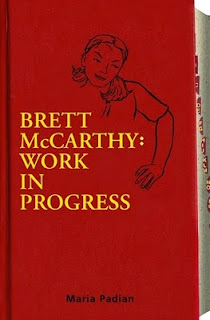
You see the basic idea, right? A dictionary. Merriam Webster's Collegiate, to be precise, and on the right are the wonderful little tabs you use to get right to the word you're looking up. The main character, Brett, is redefining herself throughout this story, so that's the theme they put right on the cover. Along with a truncated line drawing of a girl that used to be a soccer player.
I'm not going to detail my emotional reactions throughout this process, except to say my poor agent took the brunt of it. She's also the one who eventually told me it was time to stop arguing with the publisher because I was, after all, a first-time midlist author who had limited influence over this stage. And as usual, she was right. I'm no J.K. Rowling, and in this economy I should probably be grateful that I even sold a book.
I'll just say that when I visit schools today and ask the kids to raise their hands if they like to read books that remind them of dictionaries, nary a hand goes up.
Shortly after Brett launched, I learned that the paperback version would have an entirely different cover design. Today, this is what Brett looks like:
 I like it. A lot. I don't think that's necessarily Brett on the cover, but it sure looks like one of her friends. And it most definitely captures the spirit of the main character and the book as a whole.
So now, with this latest news from my publisher, I guess it's once more into the breach. Jersey Tomatoes Are the Best is about two teens from ... you guessed ... New Jersey. They are extraordinary: one is a state champion tennis player who gets recruited by a tennis academy in Florida; the other is a gifted ballerina who is chosen for a prestigious ballet school in New York. It's a story about the pressure gifted kids face as they learn to take ownership of their futures as well as deal with the expectations of the adults in their lives. It's also about friendship, and what we'll do ... or not do ... for the people we love.
I think there should definitely be tomatoes on the cover ....
Whoops. Did I just type "fun?" Did I type "wonderful?" Let's delete those adjectives and start over.
I'm at that nerve-wracking stage with my latest book where the part I control (ie. the words on the page) is complete, and now my publisher is in control (ie. creating a cover.) Before I became a published writer, I dreamed of this stage. This magic, where your tenderly crafted story is transformed from a stack of double-spaced typed pages to a realio trulio book that strangers can find in a library or bookstore.
Little did I realize, back when I was uninitiated and unpublished, that even if one has a fabulous editor (which I do) one cannot possibly prepare for the whims and fancies of the rest of the unseen horde working in that big publishing office in New York. It reminds me of sending a child off to elementary school: you think the teacher is the only adult she'll have to deal with. You never consider all the others who weigh in during your child's school days, like the mean lunch ladies, the grouchy bus driver, and the scary principal. Even with a great teacher in the classroom, those other folks influence a child's school days. Seriously.
A few months ago I saw a draft cover design for my new book, Jersey Tomatoes Are the Best, which will launch in early 2011. I really liked it. It was clever and eye catching and age appropriate and definitely something a teen would pick up. That's the key here: would a kid pick this up? Because let's face it, teen readers DO judge books by their covers.
So, I was happy. Surprisingly relieved. Because the road to the cover of my first book, Brett McCarthy: Work in Progress, was a tad bumpy. It seemed that this time, with Tomatoes, it was going to be smooth sailing.
Then, a few days ago, the bad news arrived: the lunch ladies didn't like the cover. New designs were in the making.
On the one hand, I'm grateful that so much careful attention is being given to my book. And unlike many of my writer friends, I have a publisher who puts a real effort into marketing; they did a lot to promote Brett. But I'm wary ...
Initially, Brett was titled Demigods, Brainiacs and Big, Bad News. When it came time to design the cover, my publisher wanted a different title, something which reflected that every chapter of the book began with one of the character's 8th grade vocabulary words. We conjured up 45 Definitions of Brett McCarthy and this is what the design people delivered:

I had a strong, visceral reaction to this cover. The copy at the top clearly draws on the "definitions" idea, which is cool. But the rest looked like a target at a firing range, with purple soccer girls all in a vulnerable array. And with a fatality at the bottom.
Here's the thing: no one gets shot in this book. It's a story about friendship. It's humorous. The cover clearly didn't match the "spirit" of the novel ... and we realized the problem was the title.

So, my editor and I brainstormed over the phone, and we came up with Brett McCarthy: Work in Progress. On the right is that cover:
This is the image used for the paperback Advance Reader Copies the publisher mailed to promote Brett. I liked it. It captures the main character's personality, and I loved the visual play on the work-in-progress theme. I especially liked the paintbrush with my name above it.
But then ... it got dinged. Someone somewhere in that vast building in New York felt it looked too much like a sports book and looked too "young." They wanted something that non-sportsy girls would read, and might appeal to older readers. So, back to the drawing board, and this is the version which eventually shipped in hardcover:

You see the basic idea, right? A dictionary. Merriam Webster's Collegiate, to be precise, and on the right are the wonderful little tabs you use to get right to the word you're looking up. The main character, Brett, is redefining herself throughout this story, so that's the theme they put right on the cover. Along with a truncated line drawing of a girl that used to be a soccer player.
I'm not going to detail my emotional reactions throughout this process, except to say my poor agent took the brunt of it. She's also the one who eventually told me it was time to stop arguing with the publisher because I was, after all, a first-time midlist author who had limited influence over this stage. And as usual, she was right. I'm no J.K. Rowling, and in this economy I should probably be grateful that I even sold a book.
I'll just say that when I visit schools today and ask the kids to raise their hands if they like to read books that remind them of dictionaries, nary a hand goes up.
Shortly after Brett launched, I learned that the paperback version would have an entirely different cover design. Today, this is what Brett looks like:
I like it. A lot. I don't think that's necessarily Brett on the cover, but it sure looks like one of her friends. And it most definitely captures the spirit of the main character and the book as a whole.So now, with this latest news from my publisher, I guess it's once more into the breach. Jersey Tomatoes Are the Best is about two teens from ... you guessed ... New Jersey. They are extraordinary: one is a state champion tennis player who gets recruited by a tennis academy in Florida; the other is a gifted ballerina who is chosen for a prestigious ballet school in New York. It's a story about the pressure gifted kids face as they learn to take ownership of their futures as well as deal with the expectations of the adults in their lives. It's also about friendship, and what we'll do ... or not do ... for the people we love.
I think there should definitely be tomatoes on the cover ....
Wednesday, May 26, 2010
Gardening and Writing
 It's looking like the best year ever for lupines in my garden; don't ask me why. They are a persnickety plant for sure: resisting transplanting but then growing in wild abundance in the most unlikely, inhospitable soil. Who can predict a lupine's mood? Or why it prefers roadside, salt-soaked dirt, instead of the rich compost I bestow on it?
I know you can find lupines in plenty of places outside of Maine ... I've seen riotous fields of lupines in Iceland, and gorgeous specimens in my cousin's garden in Ireland ... but ever since I read Barbara Cooney's Miss Rumphius to my children I think of them as a uniquely Maine flower. I know it's not fair to claim them, but, there you have it.
I love this time in the garden. Blue and purple predominate; the colors are still cool. The fire and heat of red bee balm, golden coreopsis and yellow daylilies is for July, when summer is ripe.
I love gardening as much as I love writing stories, and for me the process is similar. It's about completing the big picture one small step and one mundane task at a time. Head bent, hands dirty, back sore, you yank one weed then another and then another ... and when you come up for air, and step back it's ... lovely. That's how I craft a paragraph. Scratching, slow going, dead-heading and picking out the bad stuff, until I can step back, read it out loud and ... yes. It sings.
This takes a long time. And I can't let myself think about that, because in spite of my chosen avocation and beloved hobby I'm a fairly impatient person. Writing and gardening is not for people in a hurry. There's a reason why a garden is filled with slugs and snails.

Of course, in all fairness, there are also some pretty zippy creatures. Butterflies. Bees. And I've been spotting quite a few hummingbirds in this patch of Soloman's Seal. I thought they were drawn predominately to red, but the nectar in these bell-shaped buds must be pretty sweet.
I'm far from alone in drawing this comparison between gardening and writing. I know it's "been done," and done better than me, but that's not stopping me these days. I wouldn't write a word or plant a single flower if I worried about who's doing it better. I'm at the stage where all I can do is yield to my own story and admire what others create, no worry allowed.
If you're also looking to admire: a friend recently gave me The Wild Braid: A Poet Reflects on a Century in the Garden by Stanley Kunitz. It's absolutely lovely.
 Much of my garden is in shade, and I've let Sweet Woodruff carpet the edges and creep beneath the rhododendrons. Hostas, ajuga, and a few random lily of the valley mix in. I like the intentional wildness of this patch. Stanley Kunitz writes:
"Almost anything you do in the garden, for example, weeding, is an effort to create some sort of order out of nature's tendency to run wild. ... The danger is that you can so tame your garden that it becomes a thing. It becomes landscaping.
"In a poem, the danger is obvious; there is natural idiom and then there is domesticated language. ... Once the poem starts flowing, the poet must not try to dictate every syllable."
I'm not sure how that translates to writing fiction, but I'm inspired to try.
Sunday, May 16, 2010
The First Time
I recently joined a Facebook group called Children’s Authors and Illustrators, and they’ve started a discussion where folks can share their first-time publication stories.
They run the gamut. From the self-published to “A miracle occurred and they found my manuscript in the slush pile” to “My agent did it all!” There seems to be no single road to the Land of Publication, although one consistent point emerged: to fuel this journey, you’ve gotta work hard.
There is no getting around the work. Not simply the pages and pages of rewrites: we all know about revision. Not simply the emotional work of dealing with rejection and forging ahead anyway: we all know about the piles of rejection letters before the book finally sells. But the real work no one tells you about.
Years … no, decades of apprenticeship where you write fairly horrible, unreadable stuff that you file in boxes in your basement. Years when you spend most of the day at a “paying” job, only to squeeze the writing time in the slim spaces between sleep and commuting. Months you spend on the first 150 pages of a novel that seems to just write itself … only to hear from your most trusted critique partner that the concept is completely undoable and would you abandon it now, please?
But then, lightening strikes. You find your story. It’s not easy to write, but it feels good, so you go with it. Next thing you know, you’re typing “The End,” (which, by the way, is a tremendous, awesome rush) and photocopying it for readers, who tell you they love it, but …. So you fix the “buts” and send it to an agent (that’s the other thing that emerged from the Facebook discussion: nowadays you need an agent.) who loves it, but …. So you fix more “buts” and the agent sends your baby out into the wilds of first-round submissions to publishing houses and … kaboom. Someone likes it. Loves it, actually, and believes in it, and you, and is going to send you money and bind your baby with a cover and slap an ISBN number on it just to make the Library of Congress happy and Life is Good. And it seems, in that moment, that this just happened … but it didn’t. It took years, and lots and lots of hard work.
So it was with particular joy that I attended a book signing this past Saturday at the Gulf of Maine Bookstore in Brunswick, Maine, to hear my friend, Paul Doiron, read from his debut novel The Poacher’s Son. Paul is the editor in chief of Down East magazine as well as a registered Maine Guide and outdoorsman, and has written a literary detective novel set in the North Woods. It was sold as a three-book deal, has received more starred reviews than I can recount here, was reviewed in the NYTimes book review and reportedly (although Paul won’t swear to this) had an initial print run of 100,000. Now that’s a lightening strike.

Here are Paul and I at his signing at Gulf of Maine Bookstore.
But here’s the fact of the matter: even if that book had nary a starred review, a meager print run and no advance, it’s a thrill. There’s nothing quite like seeing the UPS guy pull into your driveway with that carton from your publisher. Nothing quite like ripping it open and … there it is. Your story, all dressed up like a real book.
And a signing, with an audience filled with friends, is such a gift. Gary Lawless, a poet and proprietor at Gulf of Maine, embodies the Independent Bookstore Owner Platonic Ideal. His well-stocked shelves are packed with great reads you’d never find at a chain store, and Gary and his partner, Beth, always seem to have all day to chat and share stories.
This is Gary Lawless of Gulf of Maine Bookstore.

They also know how to throw a terrific book signing! I hurried home with my copies of The Poacher’s Son and stayed up late reading about Game Warden Mike Bowditch …
Monday, May 3, 2010
Perils of Skype
I recently dipped a toe into the world of Skype Author visits … with mixed results.
For those who are even less tech-savvy than I (and few are, I suspect): Skype is free software you can download onto your computer which enables you to video-teleconference using a webcam. It’s like turning your laptop into a two-way, interactive television.
Anyway, here’s the scene: I had brilliantly scheduled a Skype meeting with an after-school book group in rural Maine for the 30-minutes before I needed to drive my daughter to her lacrosse practice. My son was supposed to be at a tennis match, and I had set up my laptop in our sunny, open-concept dining room instead of my dark, basement office. The house was quiet, the dog was outside, and I was chatting calmly into my webcam with a group of girls who had just read Brett McCarthy: Work in Progress. Then, the front door slammed open.
Oh no, I’m thinking, as I’m trying to listen to the shy girl on the screen ask a question. The match must’ve been rained out. Please don’t shout “I’m home!!” like you usually do when you open the mudroom door …
Luckily, he didn’t. He strode into the dining room, weighed down by an enormous backpack, his tennis bag, plus the mail he’d just collected, and stared curiously at me while I spoke to my laptop. He’s a fairly intelligent lad, and figured out what I was doing … so instead of speaking, he waved. He started to use sign language/charades of sorts to indicate that he was indeed home (like I didn’t know that?) and that his tennis match was cancelled. He pulled up a chair alongside me, unfolded the newspaper, and started to read the sports section.
Really? I’m thinking. This dude is really going to rattle the newspaper while I Skype? Off-camera, I made a chopping motion to him with one hand, then pointed to the other end of the house. As far as I was concerned, the meaning was clear: beat it.
The dude shrugged. He got up. He sauntered into the kitchen, which is essentially an extension of the dining room. He swung open the fridge door and began rummaging.
Yogurt, I’m thinking. Grapes. A glass of milk. Choose a silent snack. Please, no potato chips. As if he read my mind, he slammed the fridge shut. He turned and zeroed in on the new bag of Cape Cod 40-percent-lower-fat chips.
My sister, Christine Bolzan, who is something of a social media expert in the Boston area and has coached me on Skyping, says it’s very important to keep your gaze focused on the green, pinpoint light of the webcam as you speak. Otherwise, the folks on the other end see you looking into your lap, or staring off into space. Concentrate on keeping your head still; smile pleasantly, she said.
It occurred to me that I’d never asked her what the folks on the other end see if you pick up the laptop and hurl it across the room at your son. Was it Dave Letterman who pioneered MonkeyCam? I was on the verge of pioneering crazed-mother-skyping-author-cam.
“Where do you get your ideas?” one student asked as The Dude, crunching, moved on to the utensils drawer.
I hate my life I hate my life, I’m thinking, as I replied to the green light, “Well, my children have provided a lot of inspiration.” I tried not to watch, but The Dude had found a piece of blank paper and scribbled on it. He approached. He stood before me, waiting, holding his paper.
Why won’t he go away why did I ever have these children, I’m thinking, as the teacher at the school 300 miles away motioned another student up to the camera for a new question. My son, sensing a break in the action, held up his paper. A note.
“I’m going out to get something to eat. Be back soon,” it read.
YOU CAN’T TAKE THE CAR I NEED TO DRIVE YOUR SISTER TO LACROSSE PRACTICE!!! I screamed. In my head. My still head. As I smiled pleasantly at the nice students on my laptop. As I put up my off-camera hand in a “Halt!” sign, eliciting a confused, disgruntled frown from The Dude.
That’s when the Gods of Skype smiled upon me: we lost the connection. The video froze and I heard the teacher at the other end saying, “Maria, we can’t hear you. Are you there? Are you there? Well, we’re going to try to call again. Hold on everyone.”
In the 20 seconds it took to reconnect I managed to communicate with my son not only my extreme irritation at his distracting me during a Skype author visit, but the imperative that he not take the car in his search for bigger and better snacks unless he also planned to drop his sister off at lax practice. Which he did. Semi-quietly. If the folks at the other end heard any commotion, they were too polite to comment.
Author/teacher Kate Messner wrote a wonderful article about Skype Author Visits for School Library journal which I heartily recommend: http://www.schoollibraryjournal.com/article/CA6673572.html You will feel empowered when you read it. You’ll think, “I can do that! How fun! How easy!”
It is, actually. But … beware.
Subscribe to:
Posts (Atom)


